BRNSFT's Productivity Blog
Tags
- AI
- AI-assisted focus
- Agents
- Audio
- Change
- Cognitive Load
- Cognitive Science
- Context Switching
- Decent Work
- Deep Work
- Doorway effect
- Economic Impact
- Employee Engagement
- Employee Well-being
- Generative AI
- Habits
- Ikuna
- LLM
- LLM Agents
- Mental-Models
- Mindset
- Neuroscience
- Pomodoro
- Positive
- Productivity
- Routine
- Routines
- Save Workspace
- Well-Being
- Well-being
- Workplace Dignity
- attention
- attention management
- attentional residue
- burnout
- burnout prevention
- cognitive
- cognitive enhancement
- cognitiveload
- comfort zone
- concentration
- deep work
- digital nomad
- digital wellbeing
- efficiency
- environment
- ergonomics
- eventsegmentation
- focus
- home office
Latest Blogs

The Doorway Effect: Why Your Brain Wipes the Slate Every Time You Switch Apps
Every time you Command-Tab, your brain treats it as walking through a door. The literature on the doorway effect says that crossing an event boundary flushes some of the state you were holding a second earlier. On a modern Mac, you cross fifty of those boundaries a day. That's not a productivity metaphor. It's a specific finding about how the brain segments time.

Why Audio Cues Help You Focus: The Cognitive Science of Sensory Anchors
A sensory anchor is a repeatable sensory input, whether a sound, an image, a smell, or a place, that becomes associated with a cognitive state through repetition. The next time the input appears, the state loads faster and cleaner than it would from a cold start.
How Much Time Do You Actually Lose Switching Between Projects on a Mac?
Gloria Mark reported an average of 23 minutes and 15 seconds to resume interrupted work that was resumed the same day, with other tasks in between. That is not a universal refocus timer or a measured cost for every app switch.
Digital Clutter Is Costing You More Than You Think
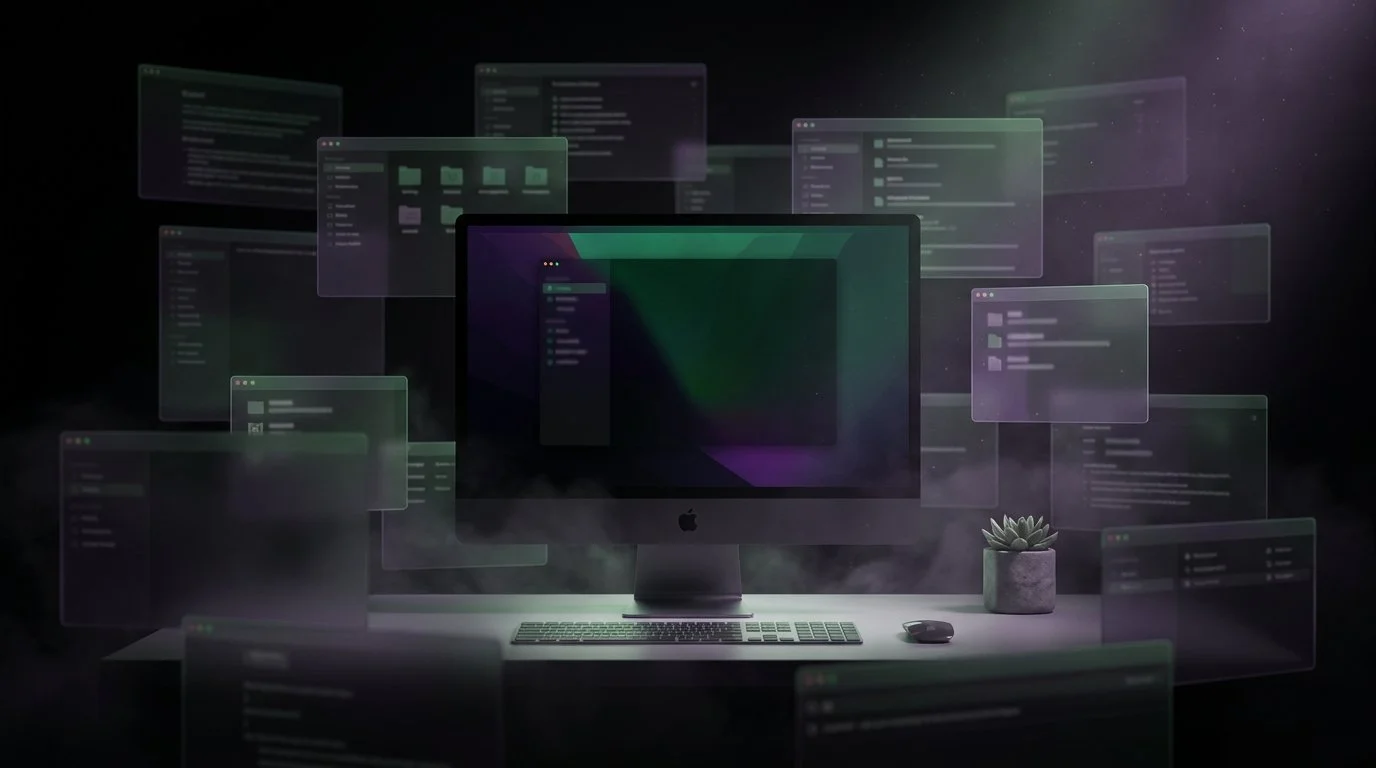
Yes. Having too many windows open on your Mac actively degrades your focus and productivity, and the mechanism is more insidious than you think.
Those windows stacked behind your active document aren't neutral. They're not just sitting there waiting patiently. Princeton neuroscientists discovered that multiple visual stimuli in your field of view compete for neural representation by mutually suppressing each other's activity throughout your visual cortex.

The Compound Cognitive Debt of the Modern Workweek
You didn't work late. You didn't pull an all-nighter. You didn't even have a particularly stressful week. Yet by Friday afternoon, you're mentally spent, unable to focus, irritable, and counting the hours until you can close your laptop. The exhaustion doesn't match the workload.

Color Is Controlling Your Focus More Than You Think
Most people think productivity lives or dies at the level of discipline.
They think the answer is better habits, stricter routines, more self-control, another optimization system, another app. So they keep adjusting the visible parts of their life while ignoring the conditions that quietly shape their behavior underneath all of it.

The Complete Mac Deep Work Setup Guide: Tools That Actually Stop Digital Chaos
Getting pulled in different directions during deep work on a Mac has two distinct causes, and most people only fix one. A complete deep work setup on Mac needs to address both. Ikuna solves the environmental layer by saving and restoring your entire workspace state in under three seconds.
Energy Management vs Time Management: A New Paradigm
Time is finite but constant. Energy fluctuates dramatically. Why managing energy trumps managing time for sustainable productivity.
The Two-Minute Rule: When Quick Tasks Steal Your Day
Small tasks feel harmless, but they accumulate into massive disruption. Learn when the two-minute rule helps and when it destroys deep work.
Designing Your Morning Routine for Peak Performance
Your morning routine sets the trajectory for your entire day. Learn evidence-based principles for designing a morning that maximizes energy and focus.
Email Bankruptcy: When and How to Reset Your Inbox
Sometimes the only way forward is to start fresh. Learn when email bankruptcy is the right move and how to execute it without burning bridges.
Batch Processing: The Efficiency Secret of High Performers
Task switching is expensive. Learn how batch processing—grouping similar tasks together—can dramatically increase your productivity.
The Perfectionism-Productivity Trap: When Good Enough Is Better
Perfectionism masquerades as high standards but often produces the opposite. Learn to distinguish productive quality focus from destructive perfectionism.
Cognitive Offloading: The Smart Way to Extend Your Memory
Your brain has limited working memory. Learn the art and science of cognitive offloading—strategically using external tools to amplify mental capacity.
Email Management for Deep Workers: Escape the Inbox
Email is the single biggest threat to knowledge worker productivity. Learn battle-tested strategies to tame your inbox without missing anything important.
Ultradian Rhythms: Working With Your Natural 90-Minute Cycles
Your brain naturally cycles between high and low alertness every 90-120 minutes. Learn to harness these ultradian rhythms for effortless productivity.
Energy Management vs. Time Management: A Paradigm Shift
Time is fixed, but energy is renewable. Learn why managing your energy—not just your calendar—is the key to sustainable high performance.
The Science-Backed Morning Routine for Peak Cognitive Performance
Your first hour sets the tone for your entire day. Discover the neuroscience behind optimal morning routines and how to design yours for maximum mental clarity.
Productive Procrastination: Using Structured Avoidance to Your Advantage
Not all procrastination is wasteful. Learn to harness structured procrastination for unexpected productivity gains.