Why Audio Cues Help You Focus: The Cognitive Science of Sensory Anchors
Audio cues aren't ambiance. They're the cheapest way to tell your brain which task you're in. When a specific sound plays every time you enter the same context, whether that's the same project or the same mode of work, your brain starts loading that context faster the next time it hears the sound. That's a fifty-year-old finding about how memory works.
Short version, if you have thirty seconds. Memory is context-dependent. Sensory cues are the cheapest form of context. Audio is the fastest of them, because you can't close your ears the way you can close your eyes. The rest of this piece is the research it rests on, plus what happens when you add a visual cue on top.
This is a companion to The Science Behind Ikuna. That piece covers the six papers that shaped the whole product. This one goes deep on one specific mechanism, the sensory anchor.
What a sensory anchor is
A sensory anchor is a repeatable sensory input, whether a sound, an image, a smell, or a place, that becomes associated with a cognitive state through repetition. The next time the input appears, the state loads faster and cleaner than it would from a cold start.
None of this is new science. It's older than psychology as a field. Pavlov's dogs are the pop-culture version. The dogs weren't salivating at the bell because bells are inherently interesting. They were salivating because a bell had been paired with food often enough that the brain had learned the association and pre-loaded the digestive response.
The uncomfortable version of that finding is that all of us are being conditioned all the time, mostly by accident, to whatever sensory environment we happen to be in when we work. For most people, most of the time, that environment doesn't carry any signal at all.
Godden and Baddeley, 1975: the diving experiment
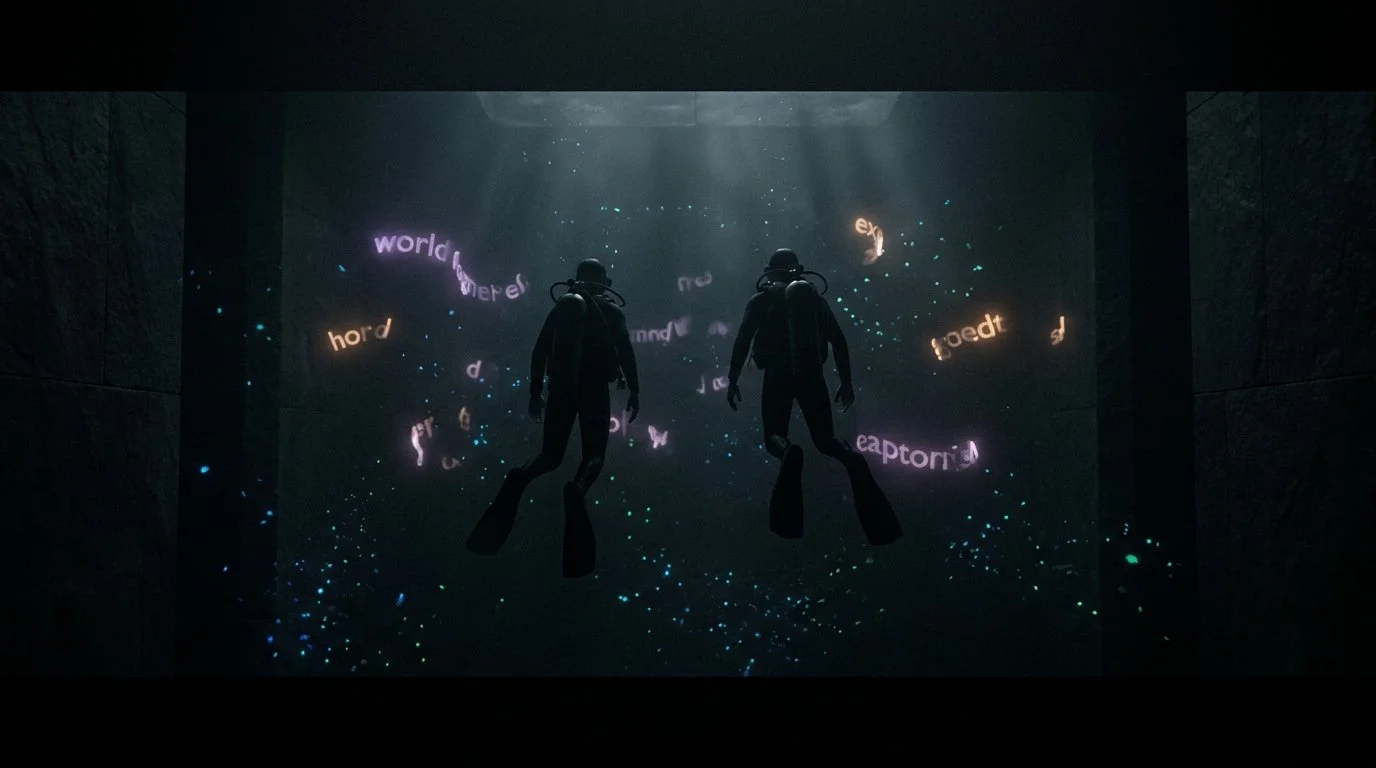
The cleanest demonstration of the effect I know of is from 1975. Godden and Baddeley took a group of divers and had them memorise word lists in one of two environments. On the beach, or eighteen feet underwater with scuba gear on. Then they tested recall in either the matching or the mismatched environment.
Recall was roughly forty percent better when the encoding and retrieval environments matched.
Some caveats belong on that number. Forty percent is specific to their study, their divers, and their word lists. It shouldn't be generalised to "any environmental match improves memory by 40%". What replicates cleanly, across dozens of follow-up studies with different environments and different stimuli, is the direction of the effect. Matching environment helps. Mismatched environment hurts. Memory isn't stored purely in your head. It's stored in the interaction between your head and the environment you were in when you encoded it.
The implication for knowledge work is a little brutal. If you plan, write, code, take calls, and file expenses all in the same browser, on the same laptop, at the same kitchen table, your brain has almost no environmental signal to distinguish them. At that point you're actively fighting context-dependent memory. Every context has to reload from scratch because there's nothing external to key it to.
Sensory anchors are the fix. Not because they do anything magical, but because they give the brain something to key to.
Why audio does more work than you'd expect
The reason to reach for audio specifically, rather than, say, changing your desk position, is that audio is fast, continuous, and hard to ignore.
Vision requires attention pointed at a screen. Look away and the visual cue disappears. Audio doesn't work that way. Once a sound is playing, the auditory system processes it whether you attend to it or not. The cocktail-party effect, the reason you can hear your name in a crowded room while ignoring everything else, is downstream of that. Your ears are always on.
The best-cited applied study on this is Mehta, Zhu and Cheema's 2012 paper in the Journal of Consumer Research, which most people know as "the coffee shop noise study". They found that moderate ambient noise around 70 decibels, roughly the sound level of a busy café, improved performance on creative-cognition tasks compared to low noise (50 dB) or high noise (85 dB). The proposed mechanism was that a moderate distraction load induces a mild processing difficulty, which pushes cognition toward more abstract, associative thinking.
That finding spawned a decade of "coffee shop noise" apps. It's worth being honest about the limits. The effect is modest, it's task-specific, and it doesn't hold for tasks that require sustained analytical focus, which prefer quieter environments. Perham and Sykora's work has shown that background music with lyrics reliably degrades reading comprehension.
The point isn't that louder is better. The point is that sound is one of the most reliable levers you have for shaping cognitive state. Specifically:
Instrumental, low-lyric, moderate-volume audio tends to help associative tasks.
Vocal, high-lyric audio tends to hurt reading and writing.
A consistent, repeated audio signature, meaning the same track or soundscape at the start of the same kind of work, is what turns audio from ambiance into an anchor.
The last bullet is the one people miss. Random music every day doesn't build the anchor. The anchor comes from the repetition, not the aesthetics of the sound itself.
Multisensory encoding: why adding a visual cue is not just decoration

If audio is one lever, vision is another. What matters is what happens when you pull both at once.
Ladan Shams and Aaron Seitz's 2008 paper "Benefits of multisensory learning" reviewed the evidence and made a fairly strong claim. Associations formed across multiple modalities, meaning audio and visual at the same time, are learned faster and retained longer than associations formed in a single modality. The brain treats the co-occurrence of two synchronised signals as more informative than either signal alone. That claim isn't folk wisdom. It's how the sensory integration circuits in the superior colliculus and the parietal cortex work.
The practical version. A distinct sound paired with a distinct visual, such as a specific wallpaper or a specific opening animation, is more anchoring than either one on its own. And according to the multisensory-integration literature, the effect is larger than the sum of the two individual cues, not just the total of them.
This is the same mechanism behind why hearing a specific song and seeing an old photograph together can pull back a memory that neither one, alone, would have surfaced. It's the same mechanism behind why a well-scored film scene is more emotionally sticky than a silent one. The pairing does the work.
Habit cueing: Wood and Neal, and why context beats willpower
Wendy Wood and David Neal's work at USC on the habit system adds one more layer. Their 2007 paper "A new look at habits and the habit-goal interface" and Wood's 2019 book Good Habits, Bad Habits argue that most of what we call "habits" are context-cued behaviours. A repeated environmental cue, meaning same time, same place, same sensory backdrop, triggers a learned response without the executive system having to weigh in. Willpower is barely involved. The cue does the work.
This connects directly to Roy Baumeister's decision-fatigue research, which I covered in the Science Behind Ikuna piece. Baumeister's point is that cognitive control is expensive, and you should conserve it. Wood and Neal's point is that context-cued habits are how you conserve it. Every decision you can offload to an environmental cue is a decision you don't have to make with your prefrontal cortex.
The office had this for free. You walked into the building, saw the same corridor, heard the same lift ping, sat in the same chair, and your brain loaded "work mode" without you having to decide anything. Remote work stripped that out. It didn't just remove the commute. It removed the entire cue stack that used to trigger the work state.
Sensory anchors are what you rebuild that cue stack out of, once the physical stack is gone. A per-context sound and a per-context wallpaper are, functionally, the digital equivalent of walking into a specific room.
The doorway problem, again
Gabriel Radvansky's 2011 study on the doorway effect showed that passing through a physical doorway causes measurable forgetting of items associated with the previous room. The brain uses doorways as event boundaries, and uses those boundaries to flush working memory.
The doorway effect is the flip side of context-dependent memory. Godden and Baddeley say matching context helps recall. Radvansky says crossing a boundary triggers a flush. Both are true. Both are useful. Together they mean that the transitions between contexts matter as much as the contexts themselves.
An audio cue at the start of a context isn't only an anchor for the context you're entering. It's also a boundary marker for the context you're leaving. It's a digital doorway. Playing the same sound every time you enter "Deep Writing" does double work. It flushes the previous context and primes the next one, in the same beat.
How Ikuna uses this: audio cue today, wallpaper and video cue next
Ikuna's Rituals & Triggers system is the applied form of this research. Every context in Ikuna can have its own opening sound, a short audio cue that plays when you enter the context. Once you set it, the sound fires automatically. You don't have to press play. The cue is tied to the context, not to a button.
For most users the effect starts to show up around day five to seven of consistent use. The first few days it's just a sound. By the second week the sound has become a signal. Hearing the "Deep Writing" cue and hearing the "Client Calls" cue produce different internal states, even before the corresponding windows finish loading. There's nothing mystical about that. It's exactly what the Godden-Baddeley and Wood-Neal literature predicts should happen with consistent pairing.
Here's the thing that made me write this article. Most people who install Ikuna never turn the audio cue on. The control isn't hidden. It sits on the context detail page under Rituals & Triggers, and the UI is fine. What's missing isn't the button. It's the reason. Without the mechanism I've just walked you through, "opening sound" reads like a novelty setting, the kind of thing you skip past on the way to something that feels more serious. It doesn't sound like a productivity tool. It sounds like a ringtone.
That's the honest gap. The audio cue is one of the highest-leverage things Ikuna does, and it's also the setting that's easiest to write off if you don't know why it's there. So this is the explanation that should have come with it. If you have Ikuna installed, open your most-used context, set an opening sound, and give it seven days. That advice isn't marketing copy. It's the direct implication of a body of research going back fifty years.
The next layer we're shipping is the visual cue. A per-context wallpaper change, plus a short opening video that fires alongside the audio when you enter a context. This isn't decoration. It's the Shams-Seitz multiplier applied directly to the Rituals & Triggers system. Audio plus visual, synchronised, at the moment of context switch. The prediction from the multisensory-integration literature is that the paired cue will build the anchor faster and hold it longer than the audio cue alone.
We'll publish the empirical results once we have them. In the meantime, this is the mechanism, and this is why it should work.
What to actually do, if you use any focus tool
You don't need Ikuna to apply this. The research doesn't care what tool you use. If you're serious about building sensory anchors for your work, the four moves are:
Pick one context to anchor first. Don't try to anchor everything. Start with the single most important recurring work state, usually deep writing or deep coding, and build the cue there. Once it holds, add the next.
Choose an audio cue you can tolerate hearing hundreds of times. Consistency matters more than aesthetics. A short instrumental loop, an ambient track, or a specific album played from the start every session all work. Variety kills the anchor.
Pair it with a visual signal if you can. A per-context wallpaper, a specific desktop, a physical position of your laptop, anything visual that fires when the audio does. Multisensory beats unisensory.
Give it a week before you judge. The anchor is a learned association. It takes repetition. The first day it's a novelty. By day seven it's a signal.
If you do this and it doesn't work, the most likely reason is inconsistency, meaning different sound, different environment, or different time. Fix the inconsistency before you conclude the mechanism doesn't hold.
FAQ
Does the specific sound matter? Less than you'd think. What matters is consistency of pairing. A short instrumental phrase used every time you enter the same context will build the anchor. A rotating playlist of "focus music" won't. The finding that matters here is Wood and Neal's on habit cueing. The strength of a cue comes from the reliability of its association with a state, not the intrinsic properties of the cue.
Is this the same thing as the Mozart effect? No. The Mozart effect, the claim that listening to Mozart raises IQ, has been largely debunked. What holds up is a much more modest and much better-supported finding, that consistent audio pairing with a task builds an anchor. That's a different mechanism from "classical music makes you smarter". One is about arousal and mood, which is transient. The other is about associative learning, which is durable.
Won't I just get used to the sound and it will stop working? Habituation is real, but it works differently than people expect. The anchor doesn't stop working because you get bored of the sound. It stops working if you break the pairing, if you start playing the sound outside the context, or if you enter the context without the sound. Consistency of pairing is what sustains it. If you keep the pairing tight, the anchor holds for years. Skilled musicians who practise to specific rituals every day have effectively been running this experiment on themselves for their whole careers.
Does it work with headphones vs speakers? Both work. Speakers are slightly stronger because they fill the room, which reinforces the "spatial" component of the anchor. Headphones are more portable, which reinforces the "modal" component. Pick whichever you'll use consistently.
What about visual cues alone, without audio? They work, but more weakly. The Shams-Seitz multisensory-integration literature is clear that paired audio-visual cues build faster and retain longer than either modality alone. Visual-only anchors work in the way that walking into a specific room works. They're real, they're just slower to build than paired cues. If you have to pick one, audio is the higher-leverage lever because it doesn't require you to be looking at anything.
Is Ikuna necessary for this? No. The mechanism works with or without a tool. What Ikuna does is make the pairing reliable. The audio cue and (soon) the visual cue fire automatically when you enter a context, so you can't accidentally break the pairing by forgetting to press play. If you can do that manually and stay consistent for weeks at a time, you don't need a tool. Most people can't, which is why the tool exists.
Sources
Godden, D.R. & Baddeley, A.D. (1975). "Context-dependent memory in two natural environments: On land and underwater." British Journal of Psychology, 66(3), 325-331.
Mehta, R., Zhu, R. & Cheema, A. (2012). "Is noise always bad? Exploring the effects of ambient noise on creative cognition." Journal of Consumer Research, 39(4), 784-799.
Perham, N. & Sykora, M. (2012). "Disliked music can be better for performance than liked music." Applied Cognitive Psychology, 26(4), 550-555.
Shams, L. & Seitz, A.R. (2008). "Benefits of multisensory learning." Trends in Cognitive Sciences, 12(11), 411-417.
Wood, W. & Neal, D.T. (2007). "A new look at habits and the habit-goal interface." Psychological Review, 114(4), 843-863.
Wood, W. (2019). Good Habits, Bad Habits: The Science of Making Positive Changes That Stick. Farrar, Straus and Giroux.
Radvansky, G.A., Krawietz, S.A. & Tamplin, A.K. (2011). "Walking through doorways causes forgetting: Further explorations." Quarterly Journal of Experimental Psychology, 64(8), 1632-1645.
Leroy, S. (2009). "Why is it so hard to do my work? The challenge of attention residue when switching between work tasks." Organizational Behavior and Human Decision Processes, 109(2), 168-181.
Ikuna is the focus intelligence and context manager for macOS. Rituals & Triggers, including per-context audio cues and (shipping next) per-context wallpaper and video cues, are available on the free plan at brnsft.com/ikuna. Pro at ikuna.app
