Color Is Controlling Your Focus More Than You Think
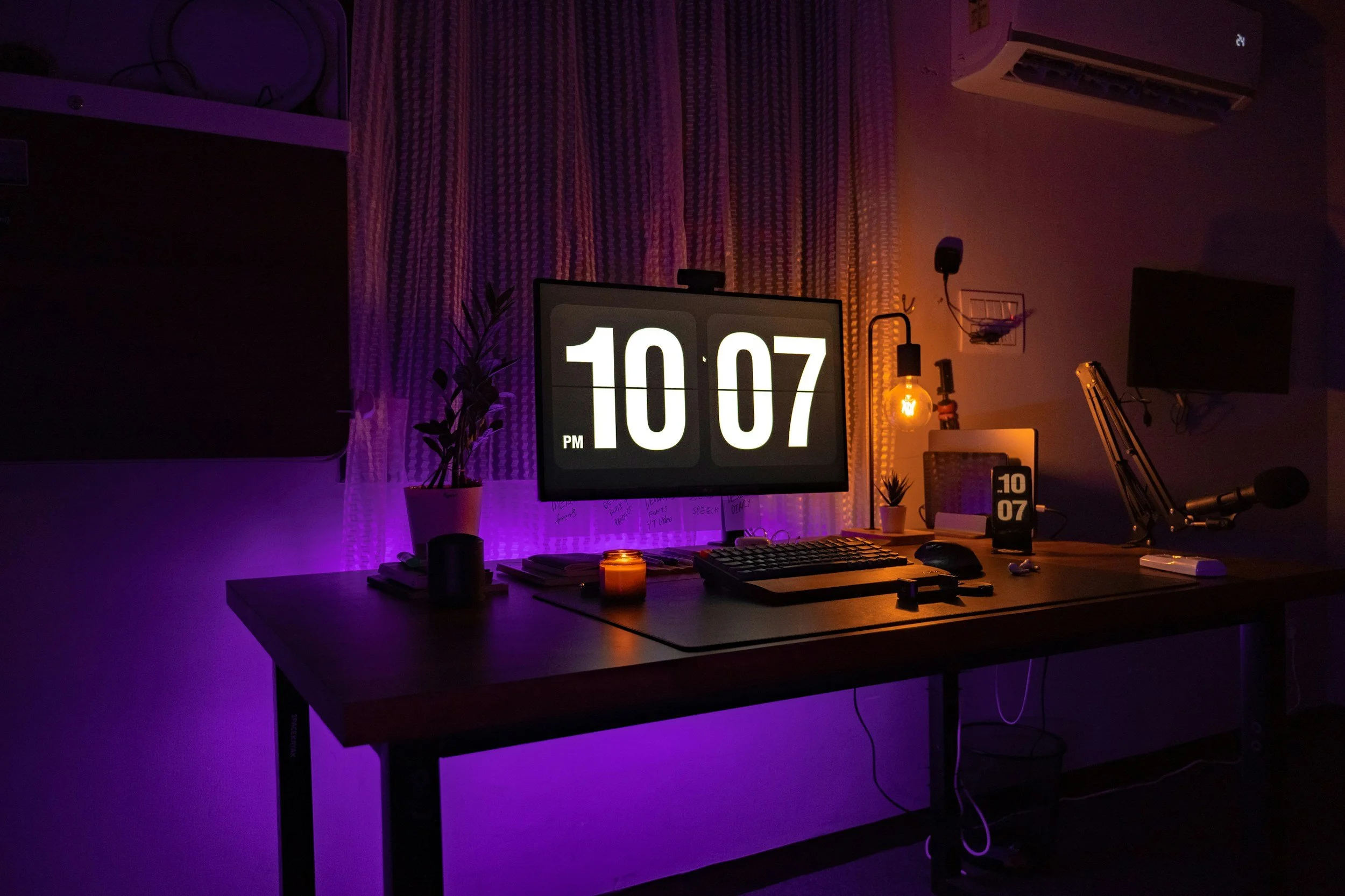
You Don’t Have a Focus Problem. You Have an Environment Problem.
Most people assume their inability to focus is personal, something that lives inside them, something they need to fix through discipline, better habits, or more control, and because of that assumption they keep adjusting themselves while leaving the one variable that constantly shapes their behavior almost completely untouched.
The environment.
Not in the obvious sense of whether the desk is clean or the chair is comfortable, but in the deeper sense of what their brain is exposed to for hours every day, because that exposure is not passive, and it does not wait for permission before it begins to influence how they think, how they feel, and how they perform.
By the time you sit down to work, your environment has already done something to you, it has already shifted your level of arousal, your sensitivity to distraction, your tolerance for complexity, and the way you approach the task in front of you, which means that what most people experience as a lack of focus is often not a failure of discipline, but a mismatch between the state their environment is creating and the state their work actually requires.
This is not just intuition, because research consistently shows that colour in work environments has a measurable impact on mood, wellbeing, and performance, not as a secondary factor, but as a core environmental variable that shapes how people function throughout the day (researchgate.net).
Once you see that clearly, the entire framing changes, because the question is no longer whether you are disciplined enough to focus, but whether your environment is even allowing focus to happen.
The state problem hiding underneath productivity advice
Most productivity advice operates at the level of behavior, telling you what to do, how to structure your time, how to remove distractions, how to stay consistent, but behavior does not exist in isolation, it emerges from state, and state is heavily influenced by environment.
This is where the Yerkes–Dodson principle becomes useful, because it shows that performance depends on having the right level of arousal, not the highest level, meaning that too little leads to disengagement while too much leads to stress and reduced cognitive performance, and optimal work happens somewhere in between.
The important part is that this range is narrow, which means that even small environmental shifts can move you outside of it without you realizing why.
And your environment is not neutral in that process.
It is constantly pushing you.
What follows from that, and where most people go wrong
If state is what determines performance, and environment is what shapes state, then the next step should be obvious, but this is where most people take a wrong turn, because instead of adjusting the environment, they double down on controlling behavior.
They try to force focus in environments that are actively working against it.
They try to stay calm in environments that increase stimulation.
They try to think clearly while surrounded by visual noise.
And because they can sometimes push through, they assume the system works, when in reality they are just compensating for friction that should not be there in the first place.
This is where the earlier discussion about color starts to matter, because color is not just one detail among many, it is one of the most consistent ways your environment shifts arousal, and that shift is happening continuously, not occasionally.
Research shows that different colours push the brain into different modes of operation, with red increasing arousal and vigilance, while blue supports broader, more flexible thinking, and crucially, that the effect depends on the type and difficulty of the task being performed (frontiersin.org).
Which means the same environment can either support your work or work against it, depending on what you are trying to do inside it.
Why modern work makes this worse, not better
This becomes more relevant when you look at how most people actually work today, because they are not starting from a neutral baseline, they are starting from a state of constant low-level stimulation, with multiple inputs competing for attention and just enough cognitive pressure that the brain never fully settles into one thing.
And then the environment adds more.
More visual signals.
More contrast.
More fragmentation.
So instead of regulating that state, it amplifies it.
Research has repeatedly shown that colours and visual environments influence not only mood but also productivity and cognitive performance, meaning that poorly aligned environments do not just feel worse, they function worse (forbes.com).
Which is why so many people feel like they cannot focus, even when they are trying.
Not because they lack discipline, but because the system is misaligned.
The real problem is not distraction, it is mismatch
At this point, the language around distraction starts to feel incomplete, because distraction suggests that something external is pulling your attention away, when in reality the deeper issue is that your environment is not supporting the kind of attention you are trying to maintain.
You are trying to do deep, cognitively demanding work in environments that continuously signal urgency, movement, and fragmentation, and then interpreting the resulting difficulty as a personal limitation instead of a structural one.
That misinterpretation is what keeps people stuck.
Because it leads them to keep fixing themselves instead of fixing the system they are operating in.
Why changing the environment works faster than changing yourself
This is also why environmental changes often feel immediate, because you are not trying to override your brain, you are changing what your brain is responding to.
If you reduce unnecessary stimulation, attention stabilizes.
If you reduce visual noise, cognitive load drops.
If you align the environment with the task, resistance decreases.
Not because you suddenly became more disciplined, but because the system became easier to operate inside.
The part almost everyone ignores: the digital environment
Even when people start thinking about environment, they usually stop at the physical layer, the desk, the room, the lighting, maybe even the color, but most knowledge work does not happen in the room, it happens on the screen, and for most people that environment is far more chaotic than the physical one.
Different applications with different visual systems, dozens of tabs competing for attention, inconsistent color schemes, constant notifications, and no clear separation between types of work, which means that every time they switch tasks, they are not just changing what they are doing, they are forcing their brain to reconfigure its entire context.
Research on cognitive task performance shows that the effect of visual and contextual variables accumulates, meaning that repeated shifts in context increase mental load and reduce efficiency over time (pmc.ncbi.nlm.nih.gov).
So even if your physical workspace is optimized, your digital one can completely undermine it.
The shift that follows from this
Once you see all of this together, the limitation becomes obvious, because most people are operating inside a single environment and expecting it to support every type of work they do, even though different types of work require different states.
Deep work requires stability and reduced stimulation.
Creative work benefits from openness and flexibility.
Administrative work tolerates structure and repetition.
But all of it is forced into the same environment.
Which means friction is not accidental.
It is built in.
Where Ikuna fits into this
This is where the idea behind Ikuna becomes relevant, not as another productivity tool, but as a way of resolving the underlying mismatch, because the real shift is not organizing windows, it is controlling environments.
Instead of rebuilding your workspace manually every time you switch tasks, you move between predefined states that match the type of work you are about to do, which means that you are no longer forcing yourself into the right mindset, but stepping into an environment that already supports it.
A deep work state can be minimal, calm, and visually quiet.
A creative state can be more open and flexible.
An administrative state can be structured and efficient.
And instead of constantly reconfiguring your setup, that shift happens instantly.
Not at the level of intention.
At the level of environment.
The bottom line
Most people are trying to fix focus at the level of behavior, which is why progress feels slow and inconsistent, because behavior follows state, and state is shaped by environment, which means that as long as the environment remains misaligned, the effort required to focus will always be higher than it needs to be, and once you change that environment, the experience of work changes with it, not because you became more capable, but because you removed the friction that was making focus difficult in the first place.