Why I Built Ikuna: The Office Stack We Lost When We Went Remote

Part of the Ikuna series — a five-piece brand story:What Is Ikuna ·Why I Built It· Updates in 2026 · More Than a Window Manager · The Science Behind It
When I went fully remote, my productivity didn't dip. It collapsed.
It wasn't dramatic on day one. I had a laptop, a kitchen table, a reasonable internet connection, and what I believed was a decade of self-discipline. By month two, I was finishing the day with the same feeling you get after a long flight: I'd been on, technically, for nine hours and could not point to a single block of real work. Meetings ran into deep work, deep work ran into messages, messages ran into a half-written doc I'd already opened twice that morning. Each evening I'd close the laptop convinced I'd just had a bad day.
It took me longer than I'd like to admit to stop blaming myself and start asking a different question: what exactly did the office do for me that I assumed I was doing myself?
That question turned into months of reading with my co-founder Pasi, then prototyping, then a product. Pasi was the one who looked at the research and saw the shape of it first: if behaviour settings, ritual entry, and attention residue are all really about cues triggering cognitive states, then the problem isn't task management and it isn't window management. It's event-trigger segmentation — giving the brain back the cues it lost. That reframing became the spine of everything we built. This is the version of that story I usually only tell in conversation. I'm writing it down because the conclusion matters more than my own anecdote: the office was running a quiet productivity stack on your behalf, and remote work removed it without telling you. Until you rebuild it deliberately, no amount of discipline closes the gap.
What the office was actually doing
When you went into an office, you walked through a sequence of cues that researchers have spent fifty years naming. The commute. The badge swipe. The same coffee machine, the same seat, the same neighbour saying the same thing. You probably didn't notice any of it. That's the point. It worked because it was invisible.
Gloria Mark's lab at UC Irvine has been measuring office work since the early 2000s. In a June 2006 Gallup interview, Gloria Mark reported that work interrupted and resumed on the same day was resumed, on average, after 23 minutes and 15 seconds, with about two intervening tasks. This measured time to task resumption, not a universal delay until full focus or 23 minutes of inactivity. In a 2008 paper she also showed something less famous but more useful: in physical offices, those interruptions came in coherent bursts, with quiet stretches in between. Knowledge workers got blocks. Remote work, for a lot of us, removed the blocks and left only the interruptions.
Sophie Leroy's 2009 paper "Why is it so hard to do my work?" put a name on what those interruptions actually cost. She called it attention residue: the part of your mind that stays attached to the previous task after you've moved on, dragging on the next one. Her experiments showed measurable performance drops on a new task when participants had been pulled away mid-flow from the previous one. In follow-up work, "ready-to-resume" planning, briefly closing out a task before switching, reduced the residue. The office did that closure for you, by making you stand up and walk somewhere else.
Then there's the work that almost nobody outside of psychology departments cites. Godden and Baddeley's 1975 study had divers learn word lists either on land or underwater, then recall them in matching or mismatched environments. Recall was 40% better when the environment matched. It's the cleanest demonstration of context-dependent memory we have, and it tells you something brutal about open-plan kitchens: the cognitive environment you learn and plan in is part of how you retrieve and execute. When every project lives in the same browser, on the same laptop, at the same kitchen table, your brain has very little to grip onto.
Environmental psychologists have a broader frame for this. Roger Barker called them behaviour settings: physical environments that constrain and cue specific behaviours, so reliably that the setting predicts behaviour better than personality does. A library is a behaviour setting. A meeting room is a behaviour setting. Your kitchen, doing seven jobs in eight hours, is not.
Put those four threads together and you start to see the actual stack the office was running.
The four mechanisms
Part of the Ikuna series: What Is Ikuna · Why I Built It · Updates in 2026 · More Than a Window Manager · The Science Behind It
When I went fully remote, my productivity did not dip. It collapsed.
It was not dramatic on the first day. I had a laptop, a kitchen table, a reliable internet connection, and what I believed was a decade of accumulated self-discipline. I assumed that working from home would mostly be a logistical adjustment. The commute would disappear, the office noise would disappear, and I would have more control over my time.
By the second month, the opposite seemed to be happening. I was ending each day with the same feeling you get after a long flight. I had technically been active for nine hours, but I could not point to a single sustained block of meaningful work. Meetings ran into deep work, deep work gave way to messages, messages led back to a half-written document I had already opened twice that morning. I was constantly doing something, yet rarely staying with anything long enough to feel that it had moved forward.
Each evening I closed the laptop convinced that I had simply had another bad day.
It took me longer than I would like to admit to stop treating this as a personal failure. Like many people, I had absorbed the idea that productivity was mainly a question of discipline. If the work was fragmented, I needed to focus harder. If I was distracted, I needed a better routine. If the day disappeared without producing much, I needed more control over myself.
Eventually I started asking a different question: what exactly had the office been doing for me that I assumed I had been doing myself?
That question led to months of reading with my co-founder, Pasi, followed by experiments, prototypes, and eventually a product. Pasi was the first to see the common structure running through the research. Concepts such as behaviour settings, ritual entry, context-dependent memory, and attention residue initially appeared to describe separate problems, but they kept pointing toward the same underlying mechanism. Human beings do not move between cognitive states through intention alone. We rely on environmental cues, repeated routines, and visible changes in context to help the brain understand what kind of behaviour is expected next.
Once we began looking at the problem in those terms, it became clear that this was not only a task-management problem, and it was not only a window-management problem. It was a problem of context segmentation. The cues that once helped separate planning from writing, meetings from deep work, and one project from another had become weaker or disappeared entirely.
That reframing became the foundation of Ikuna.
I usually tell this story in conversation rather than writing it down, but the conclusion matters far beyond my own experience. The office was running a quiet productivity system on your behalf. It created boundaries, transitions, environmental signals, and repeated patterns that helped your brain enter and leave different modes of work. Remote work removed much of that system without making the loss obvious. Until those structures are rebuilt deliberately, discipline alone rarely closes the gap.
What the office was actually doing
When you went into an office, you moved through a sequence of cues that researchers have spent decades trying to describe. There was the commute, the arrival, the badge swipe, the familiar entrance, the coffee machine, the walk to your desk, the same chair, and the same colleagues repeating many of the same routines. None of these moments seemed important in isolation, and most people probably never thought of them as part of their productivity system.
That was precisely why they worked.
The cues were stable enough to become automatic. They told the brain where it was, what was about to happen, and which behaviour belonged in that environment. By the time you sat down, a transition had already taken place. You had physically and mentally crossed from one context into another.
Gloria Mark’s research at the University of California, Irvine, has examined office work and digital interruption since the early 2000s. The figure in Mark’s June 2006 Gallup interview describes elapsed time to resume interrupted work that was resumed that day, with intervening tasks. It is not a measure of time until full attention. The exact number is memorable, but the broader pattern matters more. Interruptions do not only consume the seconds required to answer a message or check another window. They alter the cognitive state of the person doing the work.
Mark’s 2008 research also found something less widely discussed. In physical offices, interruptions often occurred in coherent clusters, with quieter stretches between them. Work was still disrupted, but it tended to happen in blocks. Knowledge workers moved through periods of interaction followed by periods in which they could remain with a task long enough to make progress.
For many remote workers, the quiet stretches became harder to protect while the interruptions remained. Communication tools expanded the number of channels through which a person could be reached, and the physical separation between types of work disappeared. A meeting, a message, a browser tab, a document, and a personal interruption could all occur in the same place, on the same device, within minutes of one another.
Sophie Leroy’s 2009 paper, “Why Is It So Hard to Do My Work?”, gave a name to the cognitive cost created by this fragmentation. She called it attention residue. The idea is straightforward: when you leave one task and move to another, part of your attention remains attached to the first task. You may have switched applications, documents, or conversations, but the mind does not always complete the transition at the same speed.
Her experiments showed measurable declines in performance when participants were pulled away from a task before they had mentally completed it. The new task received only part of their available attention because some cognitive capacity remained occupied by the unresolved work.
This helps explain why a day can feel full without feeling productive. The cost does not come only from the number of tasks you perform. It also comes from the number of incomplete transitions between them. Each switch leaves a small amount of unfinished cognitive material behind, and the residue accumulates.
In later work, Leroy explored what she called ready-to-resume planning. Participants briefly recorded where they had stopped and how they intended to continue before switching to another task. That small act of closure reduced attention residue because it gave the mind a sense that the previous task had not been abandoned. It had been paused with a clear route back.
The office often created a weaker but similar form of closure through physical movement. You stood up, closed a notebook, walked to another room, and entered a visibly different setting. The transition was not always conscious, but it gave the brain more information than clicking from one browser tab to another.
Then there is the research on context-dependent memory. In 1975, Duncan Godden and Alan Baddeley conducted a study in which divers learned word lists either on land or underwater, then attempted to recall those words in matching or mismatched environments. Recall was significantly better when the learning and retrieval environments matched.
The study is memorable because of the unusual setting, but its importance lies in what it demonstrates about memory. Information is not stored in isolation. Elements of the environment become part of the retrieval structure. The place in which you learn, plan, or solve a problem can later help reactivate the mental state associated with that work.
This has an uncomfortable implication for modern remote work. When every project lives in the same browser, on the same laptop, at the same desk, the number of distinct contextual cues becomes extremely small. The visual environment barely changes even when the cognitive demands of the work are completely different. A financial model, a strategy document, a client meeting, an inbox, and a personal conversation may all occupy the same screen within the same hour.
The brain is expected to infer the difference almost entirely from intention.
Environmental psychology offers a broader way of understanding this problem. Roger Barker developed the concept of behaviour settings to describe environments in which physical, social, and behavioural patterns reinforce one another. A behaviour setting is not merely a room or location. It is a stable combination of place, activity, expectations, and repeated cues.
A library is a behaviour setting. Its layout, social norms, sound level, furniture, and purpose all support a narrow range of behaviours. A meeting room is another. A workshop, lecture hall, laboratory, or gym each creates its own behavioural expectations before a person consciously decides what to do.
In Barker’s work, settings could often predict behaviour more reliably than personality. The implication is that people do not act only according to stable internal traits. They also adapt continuously to the environments around them. The setting carries part of the behavioural load.
A kitchen that functions as an office, meeting room, lunchroom, family space, planning studio, and place of rest does not provide the same clarity. It asks one environment to support several competing behavioural patterns. The person working there must repeatedly generate the boundaries that the setting no longer provides.
Taken together, these lines of research suggest that the office was doing far more than providing desks, meeting rooms, and access to colleagues. It was creating cognitive separation. It gave projects physical locations, gave activities distinct transitions, and gave the brain stable cues that helped it recognize what kind of attention was needed.
Most people never experienced this as a system because the system was already embedded in the environment.
Remote work did not simply move work from one building to another. It compressed multiple settings into the same physical and digital space. The commute disappeared, but so did the transition. The meeting room disappeared, but so did the cue that the previous mode of work had ended. The office desk disappeared, but so did the repeated environment associated with sustained concentration.
The result is not necessarily less time spent working. Often it is more. The difference is that the time becomes harder to divide into coherent cognitive blocks.
The four mechanisms
This is the framework I kept returning to in the research, and it eventually became the specification for what we built.
1. Ritual entry
The commute was not only transportation. It was a transition ritual. By the time you reached your desk, your brain had already done much of the work of leaving home and entering work mode. The train itself was not important. What mattered was the repeated sequence: getting dressed, leaving the house, travelling through a familiar route, entering the building, greeting the same people, and sitting down in the same place.
Repeated sequences like this become reliable triggers for cognitive states because they combine several kinds of information at once. Movement, sound, location, time of day, visual cues, and social expectations all reinforce the same message. You are no longer at home. A different mode of behaviour is beginning.
Athletes use the same principle deliberately. Warm-up routines, music, equipment preparation, and repeated gestures help create a transition into performance mode. Office workers relied on a similar mechanism without necessarily knowing it. It was embedded in the normal structure of the working day, and many people only noticed its importance after they began taking morning standups from the same room in which they had slept, eaten breakfast, and spent the previous evening.
Remote work removed the commute, but it also removed the transition. The workday could begin with no clear boundary at all. A person might wake up, check a message from bed, open a laptop at the kitchen table, and enter a meeting before the mind had received any stable indication that one part of the day had ended and another had begun.
2. Environmental anchoring
The office also gave different kinds of work distinct physical signatures. Your desk, monitor, team floor, meeting rooms, corridors, and communal areas all carried different visual and social cues. The conference room prompted one kind of attention. The desk prompted another. The coffee corner prompted a third.
This is context-dependent memory at the scale of an entire working environment. Different places held different cognitive states because they repeatedly hosted different behaviours. You did not need to reconstruct the meaning of every space each time you entered it. The environment had already accumulated that meaning through repetition.
Remote work often compresses all of those states onto a single rectangle of glass. The same monitor displays a strategy document, a video call, a private conversation, an inbox, a financial model, and a news article. The content changes, but the surrounding environment barely does. The brain receives fewer distinct signals even though the cognitive demands may be radically different.
This was the part of the stack we cared about most when we built Ikuna. Each context holds the full working state of a project: the applications that were open, the exact tabs in each browser, the position of every window, and the arrangement of multiple monitors. When you leave, the state remains. When you return, whether three seconds or three days later, you are not reconstructing the environment from memory. You are resuming it.
3. Cognitive separation between modes
The office also created transitions between different forms of work. When you moved from a meeting into a period of focused work, you usually stood up, walked through a corridor, returned to your desk, and settled into another environment. Those few minutes may have appeared unproductive, but cognitively they were doing something useful. They allowed the previous interaction to end, gave attention residue time to diminish, and signalled that a different mode of thinking was beginning.
In remote work, the same transition is often reduced to a keyboard shortcut. A meeting ends, another application comes forward, and the next task begins immediately. There is no movement, no pause, and no explicit closure. The visual content changes, but the cognitive transition remains incomplete.
This is where Leroy’s ready-to-resume research becomes especially practical. A transition does not need to be long, but it does need to contain some form of closure. Recording where you stopped, defining the next step, closing the environment associated with the previous task, and entering another one creates a clearer boundary than simply placing one window behind another.
The mistake I made for a long time was treating Command-Tab as a transition. It is not. It changes what is visible, but it does not necessarily change the state of mind associated with the work. A meaningful transition has a beginning, a middle, and an end. The previous context closes, a short separation occurs, and the new context opens.
4. State persistence outside your head
The final mechanism is the least visible and perhaps the most important. When you left an office, the environment held part of your working state for you. The whiteboard still displayed Tuesday’s diagram. The printouts remained where you had placed them. A notebook stayed open on the desk. Your colleague remembered a decision from Friday. The environment functioned as a distributed memory system.
You did not need to reload everything each morning because the office had preserved some of the state externally.
Remote work moved much of that state back into the individual. Tabs were closed, windows were reorganised, documents were lost inside recent-file menus, and incomplete decisions remained in working memory. The tools were technically available, but the surrounding state was no longer stable. Each return to a project required a reconstruction: which documents were open, where the relevant conversation had happened, what the next step was, and how the workspace had been arranged.
The human mind is not particularly well suited to holding multiple active project environments at once. Working memory is limited, and every unfinished task competes for part of it. Externalising state reduces that burden because it allows the environment to remember what the mind would otherwise need to carry.
Lose any one of these mechanisms and people usually adapt. Lose all four at once, on the same Monday, and the result resembles what many knowledge workers experienced in 2020: constant movement without the feeling of arrival.
Why discipline is not the answer
The first response, mine included, is usually to compensate with willpower. Create a stricter routine. Wake up earlier. Block more calendar time. Wear shoes indoors. Put the phone in another room. Add another productivity system.
Some of these interventions help, but they often work only temporarily because they treat a structural problem as a personal one. The office stack functioned through external cues that required little conscious effort. Willpower is internal and expensive. It can substitute for missing structure for a period, but it does so by drawing from the same cognitive capacity already required for the work itself.
Roy Baumeister’s work on decision fatigue and ego depletion is now more than two decades old, and parts of the original theory remain contested. The stronger and less controversial point is that sustained cognitive control carries a cost. Repeatedly deciding whether to focus, which task to resume, whether to ignore a message, and what mode of work you are supposed to be in creates overhead.
You do not want to spend meaningful cognitive effort determining whether you have entered work mode. You want the surrounding system to make that state easier to access.
The answer is not more productivity theatre. It is rebuilding external cues that reduce the amount of self-regulation required. That means treating context as infrastructure rather than as a matter of personal discipline.
How to rebuild the office stack at home
This is the practical part, and it is where Ikuna enters the picture. Not because Ikuna is the only possible answer, but because once the four mechanisms become visible, the shape of the solution becomes relatively clear.
Rebuild ritual entry
You need a repeatable sequence that tells your brain that a specific kind of work is beginning. Mine is simple. I close personal tabs, pour coffee, and enter my morning context. The context plays a particular piece of music and changes the wallpaper. The entire sequence takes a few seconds, but it happens consistently.
After enough repetition, the cues begin to carry meaning on their own. The music becomes associated with a certain form of work. The wallpaper signals that a particular project or mode is active. The transition no longer needs to be negotiated consciously each morning.
In Ikuna, we call these Rituals and Triggers. A context can have its own wallpaper, opening video, and playlist that activate when the context begins. The specific contents matter less than their consistency. The purpose is not decoration. It is to create a repeated sensory sequence that the brain can learn.
Rebuild environmental anchoring
Each important form of work needs its own digital environment, not only a different collection of tabs. When I enter a Customer Calls context, the screen contains the CRM, the notes document, a specific browser profile, and little else. When I enter Deep Writing, the environment contains the draft, the research material, and a deliberately quieter notification surface.
The two states should not be visually interchangeable. If everything looks the same, the brain receives little evidence that the mode of work has changed.
In Ikuna, this is handled through saved and restored contexts. Each context contains its own applications, browser tabs, window layout, and monitor arrangement, then reconstructs that environment in under three seconds. The speed is not important only because it saves time. It matters because it makes the boundary inexpensive enough to use repeatedly. A transition system that takes several minutes will eventually be bypassed. A transition that takes seconds can become habitual.
Rebuild cognitive separation between modes
You also need an equivalent of standing up and walking to another room. In a remote environment, the closest substitute is a deliberate switch event: closing the current context, pausing briefly, and then entering the next one.
The pause can be small. You might stand, stretch, take a breath, write down the next action, or simply wait for the old environment to close before the new one appears. The important feature is that the transition is perceptible.
Leroy’s ready-to-resume findings are relevant here because they show that even a brief act of closure can reduce residue. You do not need a long ritual between every task, but you do need some indication that one cognitive episode has ended before another begins.
A context switch in Ikuna closes the previous set of applications and windows, plays the trigger associated with the new context, and reconstructs the new environment. The sequence is short, but it still contains three distinct stages. That appears to matter more than the absolute duration.
Rebuild state persistence outside your head
This is the mechanism most people overlook. The office did not only provide cues. It remembered things for you. Whiteboards, papers, open notebooks, shared spaces, and colleagues all preserved elements of unfinished work.
At home, that state often lives in mental RAM. You remember which tabs need reopening, which file contains the latest version, what you intended to do next, and why a particular window arrangement mattered. Every project competes for a place inside the same limited cognitive space.
A better system allows the environment to retain that information. The application state, document state, browser state, and visual arrangement should survive your departure. When you return, the project should still resemble the project you left.
That is one of the central functions of Ikuna. A context does not merely group windows. It preserves the working environment so that resumption requires less reconstruction.
From contexts to Focus Intelligence
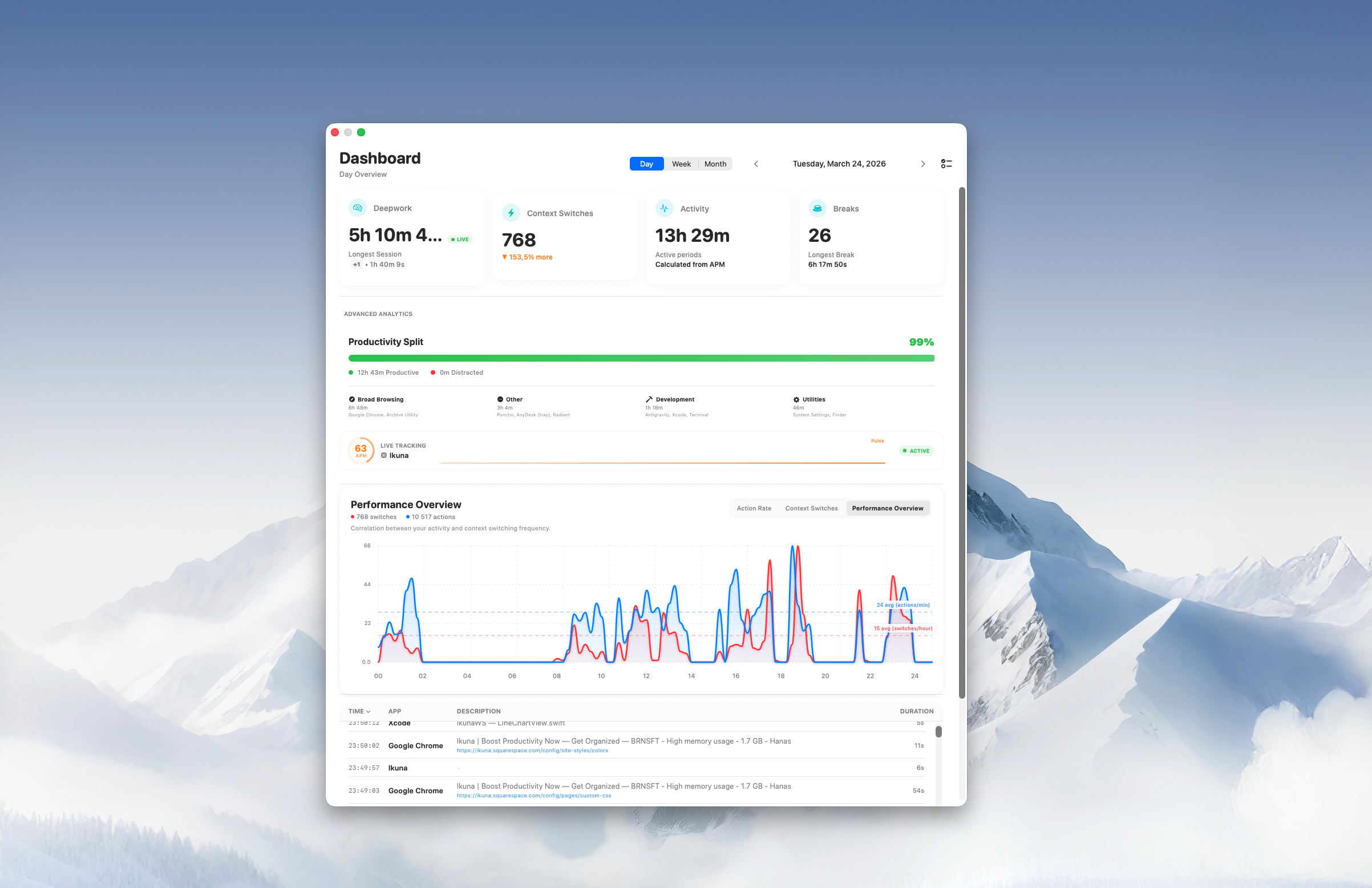
Once we had built the context layer, we realised that we had created something else as a by-product: data.
Not surveillance data and not a record of every click, but a quiet history of how someone actually focuses. How long do they remain in one context before switching? At what time of day do their longest uninterrupted blocks occur? How often does a context end before reaching twenty minutes? Which projects are repeatedly entered and abandoned? How much of a working morning is truly continuous?
This became Focus Intelligence, a way of showing users the shape of their own attention.
Most knowledge workers have never seen this information because conventional productivity tools record outputs, tasks, and time, but not the structure of cognitive continuity. A calendar tells you what you intended to do. A task manager tells you what you planned to complete. Neither necessarily tells you how fragmented your attention was while doing it.
The first time I examined my own data, I discovered that what I had been describing as a deep-work morning was, on average, six fragments of roughly twelve minutes each. I had not been lying to myself deliberately. The day simply felt more coherent from the inside than it looked from the outside.
The data performed one of the functions the office used to provide passively. It gave me an external and more honest view of my behaviour.
That is the full rebuild: a ritual for entry, an anchored environment for each context, a real transition between modes, persistent state outside the head, and a feedback layer that shows whether any of it is working.
How Ikuna actually got built
The honest version of this story includes more names than mine.
Pasi shaped the underlying idea. The first implementation came from a third person, Jurai, also known as Jurai, a programmer who worked with Pasi and me through the early years. He translated the snapping tool, window manager, and visual and audio anchors into functioning macOS software. The three of us are the reason any of this exists.
We did not begin by trying to build a window manager, snapping utility, or task-management product. We wanted to create a tool that improved productivity while protecting well-being, and the research repeatedly brought us back to the same conclusion: visual and auditory stimuli could act as anchors, helping the brain load a context and remain inside it.
That neuroscience layer was the real product, but it was not the easiest part to explain.
Anchors are a difficult thing to sell in the first ten seconds. Telling someone that an application may change their relationship with attention requires patience and trust. Window snapping, especially in 2020, produced an immediate and obvious effect. A window moved into place, the result was visible, and the value was easy to understand.
So we placed the visible magic on the surface. Snapping and layout became the immediate benefit, while the anchors remained underneath as the layer intended to create longer-term behavioural value.
Then we ran out of money.
Pasi and Jurai moved on. I continued, and Jurai kept helping where he could, because the central idea had not stopped being true and the application had not yet reached the form we believed it deserved.
From autumn 2025, I began increasing production again. Seven months later, Ikuna is stable, the anchors are implemented, and I am now doing two things in parallel. The first is listening closely to people who use the product in their daily work. The second is conducting small-scale research with Ikuna itself as an instrument, measuring deep work, cognitive switching, and the practical effect of visual and audio anchors against the literature from which they emerged.
An iOS application is next on the roadmap.
If Ikuna appears to be a window manager at first glance, that is understandable. It is the surface we deliberately placed in front. Underneath is a larger research argument about attention, environment, memory, and cognitive transitions. The work now is to keep testing that argument through the product, through what users report, and through the research the product itself makes possible.
What I would tell my pre-remote self
If I could send one note back to the version of myself who closed the office door for the last time, it would be this: the office was not only a place where you worked. It was a collection of running processes that you did not know were running.
When you go remote, those processes do not move with you. They stop.
The first few weeks may feel fine because you are still carrying the habits and associations built in the previous environment. Later, the symptoms begin to appear. You adjust sleep, exercise, scheduling, communication tools, and task systems without recognising that the underlying structure has disappeared.
You do not need to recreate the office. It was not perfect, and much of what people miss about it is social rather than cognitive. But you do need to rebuild the mechanisms it provided: ritual entry, environmental anchoring, cognitive separation between modes, and state persistence outside the head.
Once those mechanisms return, in whatever form suits your life, some of the productivity that seemed to disappear under remote work begins to look less like something lost and more like something stranded in an environment you no longer visit.
That is why we built Ikuna. Not as a workspace switcher, launcher, or another macOS utility, but as a small piece of infrastructure that restores those mechanisms inside the device where modern work now lives.
FAQ
Why did remote work hurt focus so much for some people and not others?
The research suggests that the answer depends partly on how much of a person’s focus infrastructure was external. People whose work mode was strongly triggered by a commute, dedicated desk, office routines, and physical separation lost more when those cues disappeared.
People who had already spent years working independently, freelancing, or moving between self-created environments may have developed stronger internal or portable triggers. They were not necessarily more disciplined. They had learned to run a different system.
Individual differences also matter. Some people are more sensitive to environmental cues, interruptions, social expectations, or the absence of physical boundaries. The point is not that remote work affects everyone equally. It is that its costs are partly determined by which cognitive supports were previously supplied by the environment.
What does the 23-minute task-resumption figure describe?
In Mark’s June 2006 Gallup interview, interrupted work resumed that day was resumed after an average of 23 minutes and 15 seconds, with about two intervening tasks. It is an observed average, not a fixed delay for each interruption.
It also requires careful interpretation. It does not mean that every interruption causes exactly 23 minutes of complete inactivity. People often perform other work during that period. The more durable conclusion is that meaningful interruptions cost more than the interruption itself because returning to the previous task requires cognitive reorientation.
The precise number is less important than the reload cost.
What is attention residue, and how is it different from distraction?
Attention residue, as defined by Sophie Leroy, is the cognitive trace of a previous task that remains after a person has moved to another one. It is not the same as being distracted in the moment.
You may be looking directly at the new task and still perform worse because part of your attention remains engaged with unfinished work. The residue is especially strong when the previous task was interrupted before reaching a natural stopping point.
Leroy’s later research showed that ready-to-resume planning can reduce this effect. Briefly recording where you stopped and how you will continue helps the mind release the previous task more completely.
This is one reason a real context switch needs some form of closure.
Why can I not just use macOS Spaces or Stage Manager?
You can use them for the window-grouping part. Spaces and Stage Manager are useful for visually separating applications and windows.
What they do not provide is full restoration of a project context after it has been closed. They do not reopen the exact browser tabs, reconstruct the application and monitor layout, trigger a repeated entry ritual, or show how attention behaves across different contexts over time.
They manage the visible surface. Ikuna is intended to address the deeper mechanisms underneath it.
Where do environmental psychology and behaviour settings fit in?
Roger Barker’s concept of behaviour settings provides the broadest frame for the argument. Physical and social environments cue behaviour so consistently that, in some contexts, the setting predicts behaviour better than personality.
The office contained several behaviour settings at once. The desk, meeting room, kitchen, corridor, and workshop each supported different activities and expectations.
A home office often asks one environment to support many incompatible modes. The same room becomes a place for meetings, concentrated work, family life, administration, entertainment, and rest. The cues become weaker because the setting no longer points reliably toward one form of behaviour.
The goal is to give each mode a distinct setting again, digitally when physical separation is not possible.
Rebuilding the invisible stack
The office gave knowledge workers more than desks and meeting rooms. It supplied transitions, environmental cues, stable project states, and external memory. Much of that infrastructure was so ordinary that it disappeared from view.
Remote work revealed its value by removing it.
Ikuna is our attempt to rebuild that invisible stack inside the computer. It restores full project contexts, including applications, browser tabs, windows, and monitor layouts, in under three seconds. It supports per-context rituals through visual and audio anchors, and it gives users a clearer view of their own attention through Focus Intelligence.
Ikuna is available on macOS. You can start with the free plan at brnsft.com/ikuna or explore Pro at ikuna.app.
