Digital Boundaries Are the New Work-Life Balance
Your laptop doesn't know when you're done working. Neither does your brain. And that's the problem.
The traditional work-life balance conversation assumes you can leave work at work. But when your office is a Chrome tab and your commute is closing your laptop lid, the psychological boundary between "working" and "living" collapses entirely. You're not struggling with balance. You're struggling with the absence of boundaries.
The research is unambiguous: without a clear separation between work and non-work roles, your brain never fully disengages. And without disengagement, there is no recovery. Without recovery, there is burnout.
The Boundary Theory You've Been Living Without
In 2000, organizational psychologists Blake Ashforth, Glen Kreiner, and Mel Fugate published foundational research on boundary theory the framework that explains how people create, maintain, and negotiate the lines between work and home roles. Their key finding: people fall on a spectrum from "segmentors" (who prefer strict separation) to "integrators" (who blend roles fluidly).
Neither approach is inherently better. What matters is alignment: segmentors thrive when they can maintain clear boundaries; integrators thrive when they can move flexibly between roles.
Here's what changed: the digital workplace has forced everyone into integration mode, whether they want it or not. Slack notifications during dinner. Email on your phone at 9 PM. The same browser window that holds your work tabs also holds your personal banking, your streaming services, your life.
For natural segmentors, people who need clear role separation to function this is psychological chaos. But even integrators suffer when boundaries become involuntary. The issue isn't integration itself; it's the loss of control over when and how roles blend.
Why Your Brain Can't Turn Off
Sabine Sonnentag and Charlotte Fritz have spent two decades studying psychological detachment the ability to mentally disengage from work during non-work time. Their research, published across multiple studies from 2007 to 2015, establishes a clear causal chain:
Failure to detach from work predicts emotional exhaustion, reduced life satisfaction, poor sleep quality, and increased need for recovery. Conversely, people who successfully detach report better well-being, higher job satisfaction, and lower burnout risk.
Detachment isn't about physical distance. It's cognitive. Sonnentag and Fritz define it as "the individual's sense of being away from the work situation." You can be physically at home and psychologically still at work, ruminating about an unfinished project, mentally drafting an email, replaying a difficult conversation.
The mechanism is straightforward: work demands deplete cognitive and emotional resources. Recovery requires stopping the depletion. If you never stop thinking about work, you never recover. The tank stays empty.
Here's the trap: the same devices and digital environments that enable remote work also prevent detachment. Your laptop is simultaneously your work tool and your personal device. The context never changes. Your brain has no environmental cue that work has ended.
The Triple Peak Day and the Always-On Culture
Microsoft's 2021 Work Trend Index documented a phenomenon they called the "triple peak day." Pre-pandemic, workplace activity showed two peaks: mid-morning and mid-afternoon. Post-pandemic, a third peak emerged: 9 PM to midnight.
People weren't working longer hours by choice. They were responding to the boundary collapse. Work bled into evenings because there was no structural barrier to stop it. No office to leave. No commute to create a transition. Just a continuous digital environment where work and life coexist without separation.
Research on "always-on" culture confirms the damage. A 2020 study by Dettmers, Bamberg, and Seffzek found that constant connectivity, the expectation of availability outside work hours, directly undermines psychological detachment. The mere possibility of work contact prevents full disengagement, even when no actual work occurs.
You don't need to be actively working to fail at detachment. You just need to be in an environment where work can happen. Where the tools are present. Where the context is ambiguous.
Physical Offices Were Boundary Machines
The traditional office provided something we didn't fully appreciate until it was gone: automatic boundary enforcement.
The commute was a transition ritual. The physical separation of workspace from living space created environmental clarity. When you left the building, work stayed there. Your brain received unambiguous signals: this role is over, that role begins.
Christena Nippert-Eng's 1996 book Home and Work introduced the concept of boundary work, the active effort people invest in creating and maintaining role boundaries. She documented how people use physical artifacts and daily rituals as boundary markers: separate calendars, different clothing, distinct spaces.
The office building was the ultimate boundary artifact. You didn't have to think about separation; the architecture did it for you.
Remote work eliminated that artifact without replacing it. We kept the same laptop, the same desk, the same browser. We lost the boundary mechanism but not the psychological need for boundaries.
The solution isn't returning to offices. It's creating digital boundary artifacts that serve the same function.
Workspace Separation as a Well-Being Practice
This is where most productivity advice gets it wrong. Workspace separation isn't a hack for focus or efficiency. It's a psychological boundary mechanism a way to create the environmental clarity your brain needs to detach.
The research points to a specific solution: role-specific environments. If your brain associates a particular digital context with work and a different context with non-work, you create the cognitive separation that enables detachment.
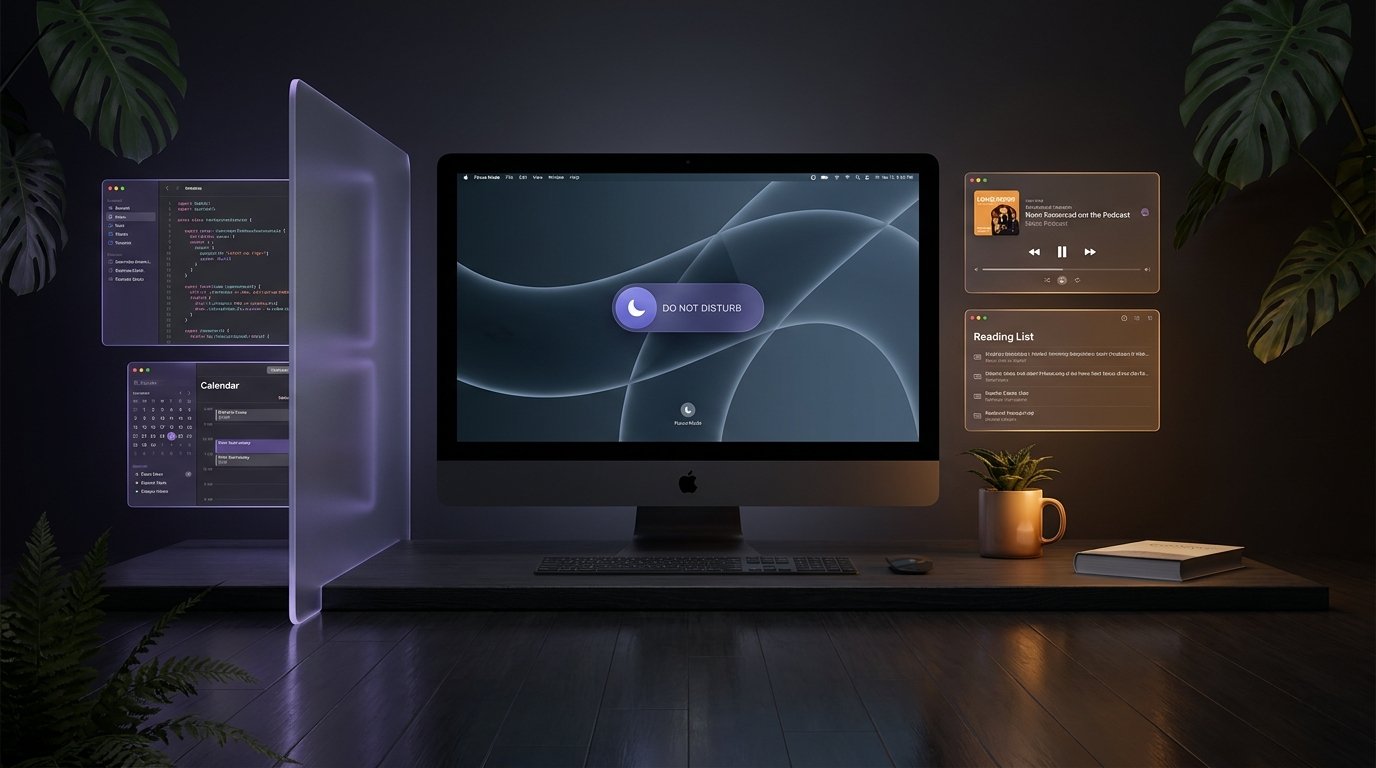
Ikuna automates this boundary work. You define distinct workspaces as complete environments with specific apps, browser tabs, window arrangements, and Focus Mode settings. When you switch workspaces, everything changes. Your work context closes entirely. Your personal context opens.
This isn't about productivity. It's about creating the digital equivalent of leaving the office. When you end your workday, you don't minimize windows or close a few tabs. You switch contexts entirely. The work environment disappears. Your brain receives the same unambiguous signal that a commute once provided: this role is over.
For segmentors, this is essential. For integrators, it's the ability to control when roles blend rather than having them forced together by default.
The mechanism aligns directly with Sonnentag's detachment research: environmental change supports cognitive disengagement. When the visual and functional context shifts completely, your brain can let go of work-related thoughts. The boundary becomes real.
The Recovery Equation
Here's what the research tells us about recovery:
Work demands deplete resources (cognitive, emotional, physical)
Recovery requires cessation of demands (Meijman & Mulder, 1998)
Psychological detachment is the primary recovery mechanism (Sonnentag & Fritz, 2015)
Environmental cues facilitate or prevent detachment (Nippert-Eng, 1996)
The equation is simple: No boundaries → No detachment → No recovery → Burnout.
You can't recover while remaining in the environment where depletion occurs. You can't detach while surrounded by work artifacts. You can't maintain well-being without protecting your capacity to mentally leave work behind.
This isn't about working less. It's about recovering fully. People who detach effectively can sustain higher performance over time because they actually replenish their resources. People who never detach operate in a permanent state of depletion.
The boundary isn't a limitation. It's the mechanism that makes sustained performance possible.
What About Flexibility?
The obvious objection: "But I like being able to check work email from my couch. I don't want rigid separation."
Boundary theory accounts for this. Remember: integrators exist. Some people genuinely prefer fluid role boundaries. The problem isn't integration itself it's involuntary integration.
The question isn't whether you should separate work and life. It's whether you can separate them when you need to.
Flexibility requires control. If you can't create separation, you don't have flexibility; you have forced integration. True flexibility means being able to choose: integrate when it serves you, separate when you need recovery.
Digital workspace separation gives you that choice. You can maintain a personal workspace that excludes work entirely. You can create a hybrid workspace for light evening tasks. You can design your environments to match your actual boundary preferences rather than accepting the default of "everything, everywhere, all the time."
The Well-Being Stack
This is article three in a series on digital well-being. The previous articles covered attention architecture and context switching costs. This piece adds the boundary layer.
Well-being isn't a single intervention. It's a stack of practices that work together:
Attention architecture: designing your environment to support focus
Context management: reducing the cognitive cost of switching between roles
Boundary work: creating separation that enables psychological detachment
Each layer reinforces the others. Attention architecture reduces depletion. Context management makes transitions efficient. Boundary work protects recovery.
The digital workplace broke all three. We're rebuilding them deliberately, with tools designed for the way we actually work now.
FAQ
Q: Isn't this just about willpower? Can't I just decide to stop thinking about work?
No. Sonnentag's research shows that psychological detachment isn't a willpower problem it's an environmental one. Your brain uses context cues to determine which mental mode to activate. If the environment contains work artifacts (open Slack, visible project tabs, work email in the dock), your brain remains in work mode regardless of your intentions. Willpower depletes. Environmental design doesn't.
Q: I work from my phone too. Does workspace separation even matter if I can access everything from my pocket?
Yes, but you're identifying the next boundary to address. Desktop workspace separation handles the primary work environment where you spend 6-8 hours daily. Phone boundaries require different mechanisms: notification management, separate work profiles (iOS Focus Modes, Android work profiles), or simply removing work apps from personal devices. The principle is the same: create environmental clarity that supports detachment.
Q: What if I need to be available for emergencies?
Boundary theory distinguishes between permeability (how easily elements from one role can enter another) and flexibility (your control over when crossing occurs). True emergencies are rare and can be accommodated with specific protocols a phone call from your manager, a dedicated emergency contact method. What most people call "emergencies" are actually always-on expectations that prevent detachment. Define what actually qualifies as urgent, create a single channel for it, and protect everything else.
Q: Won't this make me less productive? I do some of my best thinking about work problems in the evening.
Detachment research shows the opposite: people who detach fully during non-work time report higher job performance and creativity (Fritz et al., 2010). The "evening thinking" you're describing often isn't productive insight it's rumination, which depletes resources without generating value. Real creative breakthroughs happen when your brain has actually rested. Protect your recovery time and your work quality improves.
Q: How is this different from just closing my laptop?
Closing your laptop is a physical action without environmental change. When you reopen it, everything is exactly as you left it work tabs, Slack, project files. Your brain sees the same context and reactivates work mode. Workspace separation creates a complete context shift. When you open your laptop in personal mode, you see a different environment entirely. The boundary is environmental, not just physical.
Ikuna creates digital boundaries that protect your capacity to detach. Define your workspaces, switch contexts completely, and give your brain the environmental clarity it needs to recover. Learn more at brnsft.com.
